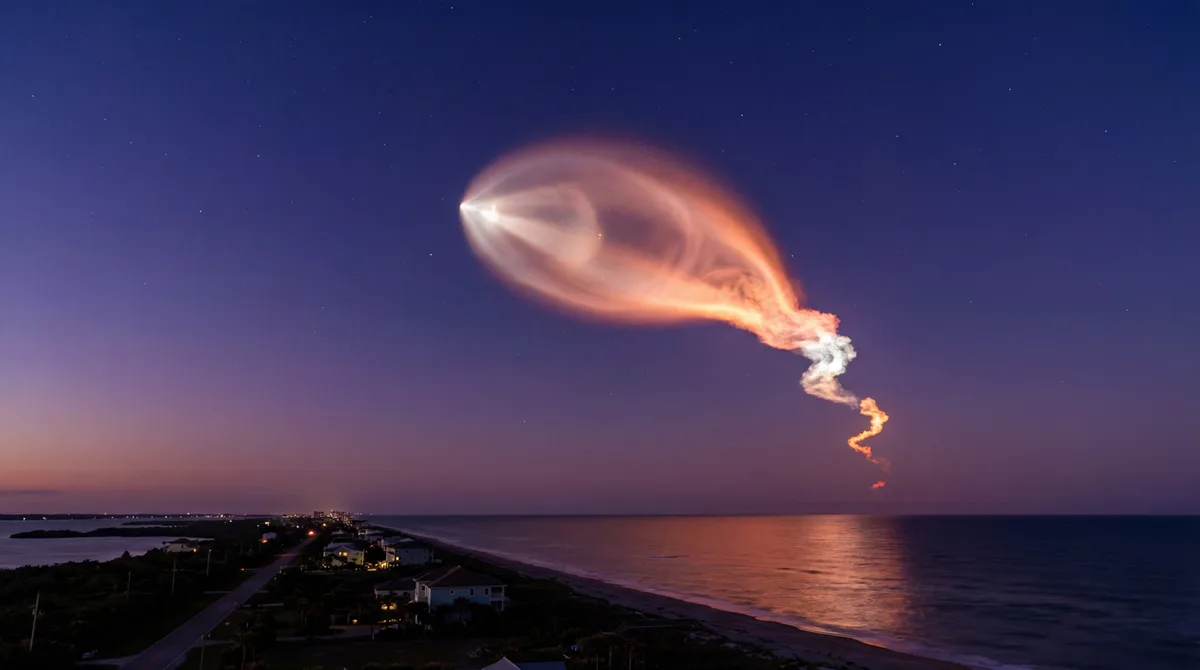
A SpaceX Falcon 9 rocket launched from Cape Canaveral Space Force Station at 5:52 a.m. EST on Wednesday, March 4, 2026, carrying 29 Starlink satellites to low-Earth orbit. The rocket lifted off from Launch Complex 40, with sunlight hitting its contrail to create a visible 'jellyfish' effect in the sky. Craig Bailey and Malcolm Denemark of FLORIDA TODAY captured images of the phenomenon, which lasted for several minutes after liftoff. The exhaust plume from the rocket’s first stage remained visible for over 20 minutes, stretching across the sky in a glowing, translucent shape resembling a jellyfish. Local residents and skywatchers reported seeing the unusual sight, with some posting photos on social media. The Falcon 9’s first stage returned to Earth safely, landing at Cape Canaveral’s Landing Zone 1. SpaceX has conducted over 100 Starlink launches since 2019, with this mission marking the 30th operational flight of the Falcon 9’s Block 5 variant. The satellites are part of SpaceX’s effort to expand global broadband coverage, with thousands more planned for deployment in 2026. The launch was the second from Cape Canaveral this month, following a United Launch Alliance mission on February 28. No delays or technical issues were reported during the flight, which reached an altitude of 325 kilometers before deploying the satellites. The 'jellyfish' effect, caused by sunlight refracting through ice crystals in the contrail, is a common but striking visual phenomenon after rocket launches in clear conditions. SpaceX’s next Starlink mission is scheduled for March 18 from the same launch complex.
Space & Tech
SpaceX rocket's 'jellyfish' contrail seen over Brevard after March 4 launch
A SpaceX Falcon 9 rocket created a 'jellyfish' effect in the sky over Cape Canaveral on March 4, 2026, as it launched 29 Starlink satellites.
Source: Florida Today