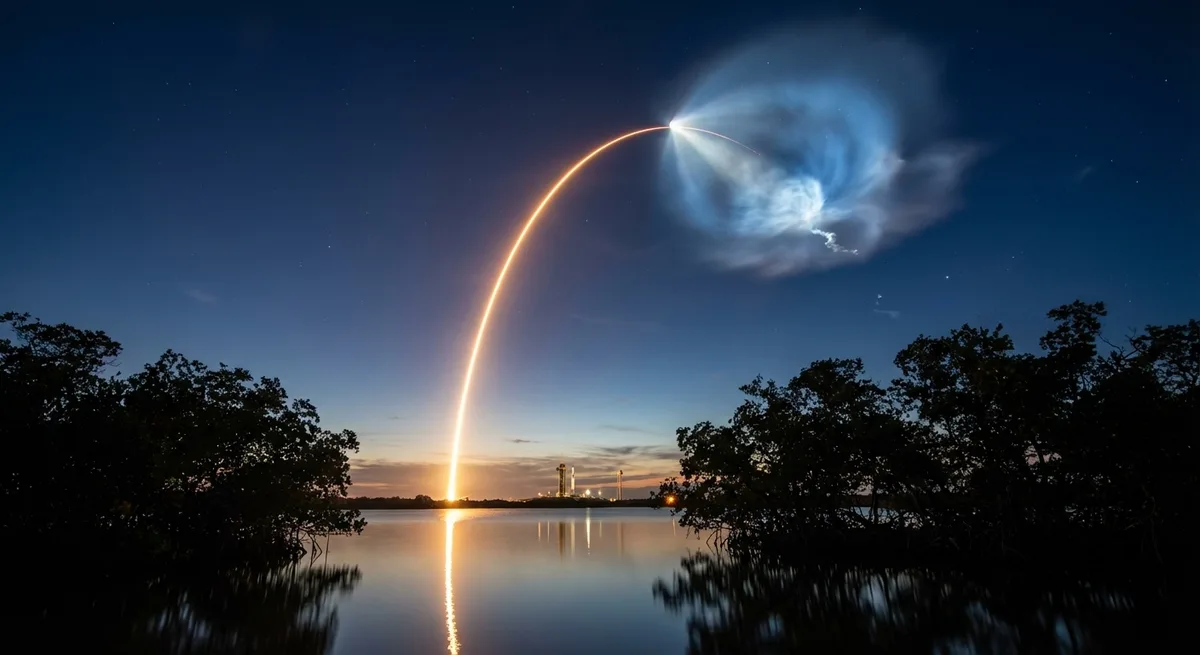
SpaceX is targeting a 6 a.m. launch Thursday, March 12 from Launch Complex 40 at Cape Canaveral Space Force Station to send 53 Starlink satellites into orbit. The mission, designated Starlink 10-48, will follow a northeast trajectory that could make the rocket visible across parts of the East Coast if liftoff occurs before sunrise. The launch window extends to 10 a.m. if needed, but visibility is only possible if the rocket clears the pad while it is still dark. Sunrise in Cape Canaveral is scheduled for 7:33 a.m., giving a narrow 30- to 40-minute window for the launch to occur before sunlight washes out the view. The 'jellyfish effect'—a swirling display of blue and pink light caused by sunlight refracting through the rocket's exhaust plume—was last seen in Florida on March 4 when a previous Starlink mission launched just before dawn. That phenomenon depends on the rocket's exhaust interacting with atmospheric conditions at a precise angle just below the horizon. If this launch occurs 30-40 minutes before sunrise, observers in Florida, Georgia, and the Carolinas may see a similar display. The Florida Today Space Team will provide live updates 90 minutes before liftoff at FloridaToday.com/Space. Weather remains a potential hurdle, with a 60% chance of favorable conditions at launch time. If delayed past sunrise, the jellyfish effect will not occur. SpaceX has conducted 103 Starlink launches since 2019, with 4,600 satellites already in orbit. This mission will expand broadband coverage in rural areas, though no specific regions were named in the flight plan. The Falcon 9's first stage will land at Cape Canaveral's Landing Zone 1, marking the first reuse of that site since 2023.
Space & Tech
SpaceX rocket launch from Cape Canaveral may offer rare 'jellyfish effect' predawn show
SpaceX's next Falcon 9 launch from Cape Canaveral on March 12 could create a rare 'jellyfish effect' if it lifts off shortly before sunrise.
Source: Florida Today