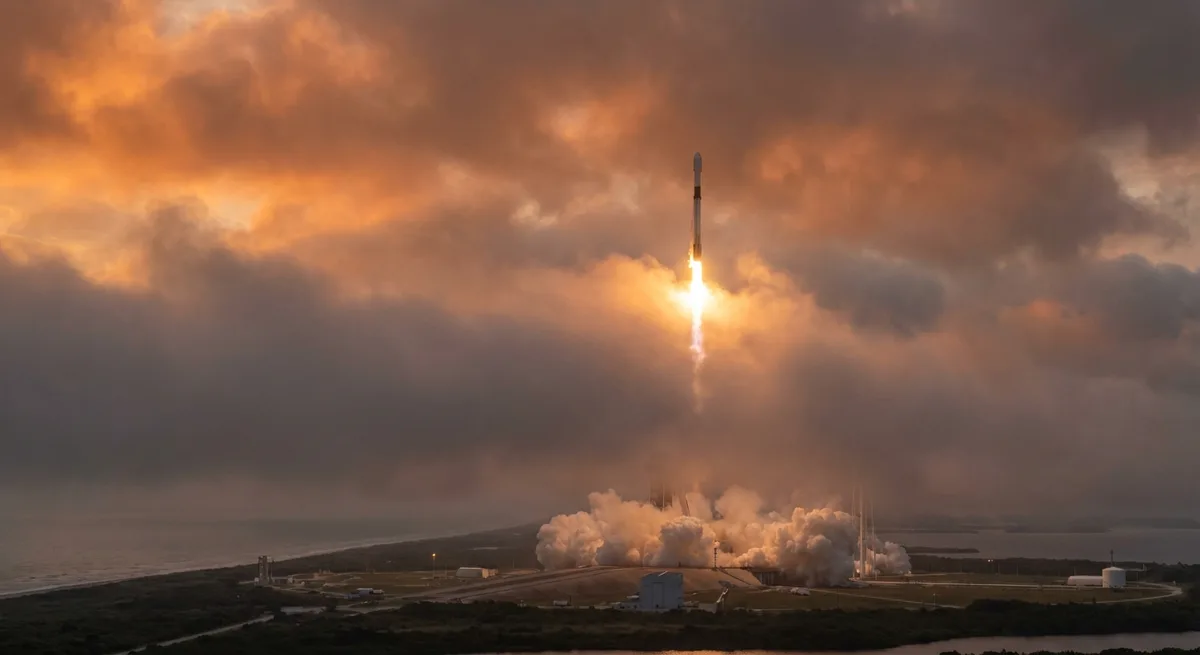
SpaceX launched 29 Starlink satellites from Cape Canaveral Space Force Station on Friday morning, Feb. 26, 2026, despite concerns over cloud cover. The Falcon 9 rocket lifted off at 7:17 a.m. ET from Space Launch Complex 40, within a launch window that opened at 4:52 a.m. and closed at 8:52 a.m. The 45th Weather Squadron had rated the conditions at 85% favorable, with cumulus clouds being the primary concern. The mission, called Starlink 6-108, is part of SpaceX's ongoing effort to expand global broadband coverage.
This flight marked the 30th launch of the Falcon 9's first-stage booster, B1069, a veteran rocket that has completed 29 previous missions. The booster is expected to land on the droneship A Shortfall of Gravitas in the Atlantic Ocean after stage separation. B1069 is one of the oldest active first-stage boosters in SpaceX's fleet, having previously supported missions including cargo resupply flights to the International Space Station and satellite deployments for Eutelsat and OneWeb.
The 29 Starlink satellites will join thousands already in orbit, providing internet service to underserved regions. Dr. Jonathan McDowell, an astrophysicist at the Harvard-Smithsonian Center for Astrophysics, tracks Starlink's constellation. As of before this launch, 9,826 Starlink satellites were in orbit, with 8,352 operational. SpaceX has conducted 25 Starlink missions to date, with this launch bringing the total to 26.
The mission faced a minor hurdle with the cumulus cloud rule, which requires clear skies for visual tracking of the rocket's ascent. However, the 85% favorable weather forecast allowed the launch to proceed. SpaceX has a history of launching through less-than-ideal conditions, relying on advanced weather modeling and real-time data from the 45th Weather Squadron to make go/no-go decisions.
The Starlink satellites will deploy into low-Earth orbit, where they will form part of a network aimed at connecting remote areas with high-speed internet. This mission follows a series of successful Starlink launches in recent months, as SpaceX continues to expand its constellation ahead of potential regulatory and technical challenges.