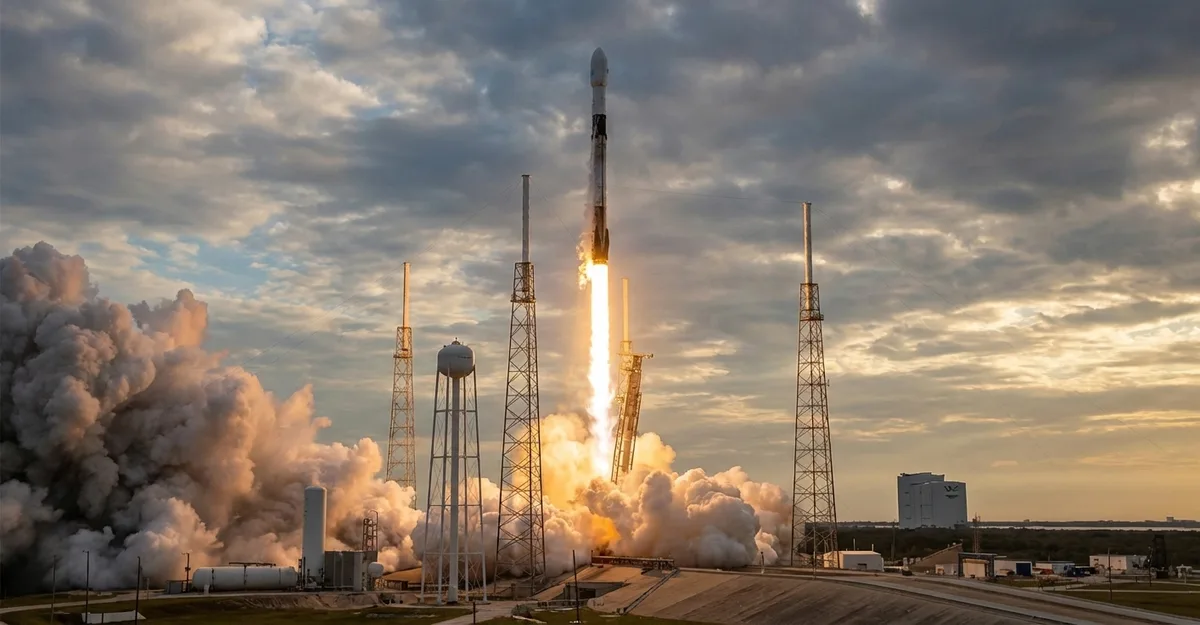
SpaceX launched a Falcon 9 rocket from Cape Canaveral Space Force Station’s Space Launch Complex 40 at 8:37 a.m. on March 14, 2026, marking the company’s 24th anniversary and coinciding with National Pi Day. The rocket carried 29 Starlink satellites to orbit, continuing SpaceX’s efforts to expand its global internet constellation. The launch commentator added a special touch to the countdown, inserting ‘Pi’ at the number 3 during the sequence: ‘10, 9, 8, 7, 6, 5, 4, Pi, 2, 1, ignition.’
The first-stage booster, which had previously flown five times, landed successfully on the droneship Just Read the Instructions in the Atlantic Ocean. This was the 18th launch of the year from the Space Coast, with SpaceX accounting for all but one of those missions. Combined with launches from California, the company has already flown its Falcon 9 rocket 32 times in 2026, on track to approach the 165 total missions it completed in 2025.
SpaceX’s Starlink constellation now includes nearly 10,000 satellites in orbit, according to astronomer Jonathan McDowell. The company’s first Falcon 1 rocket launch in 2006 ended in failure, but after three attempts, it achieved orbit in 2008. The Falcon 9, which has since become a workhorse for SpaceX, has been reused multiple times in recent missions, including this one.
The launch comes as SpaceX continues to dominate the East Coast’s spaceflight schedule, with 101 of its 2025 missions originating from Kennedy Space Center or Cape Canaveral Space Force Station. The company’s ability to recover and reuse boosters has been a key factor in its rapid mission pace, reducing costs and increasing frequency. With this latest flight, the Falcon 9’s sixth mission, SpaceX reaffirmed its commitment to frequent, reliable launches from Brevard County.