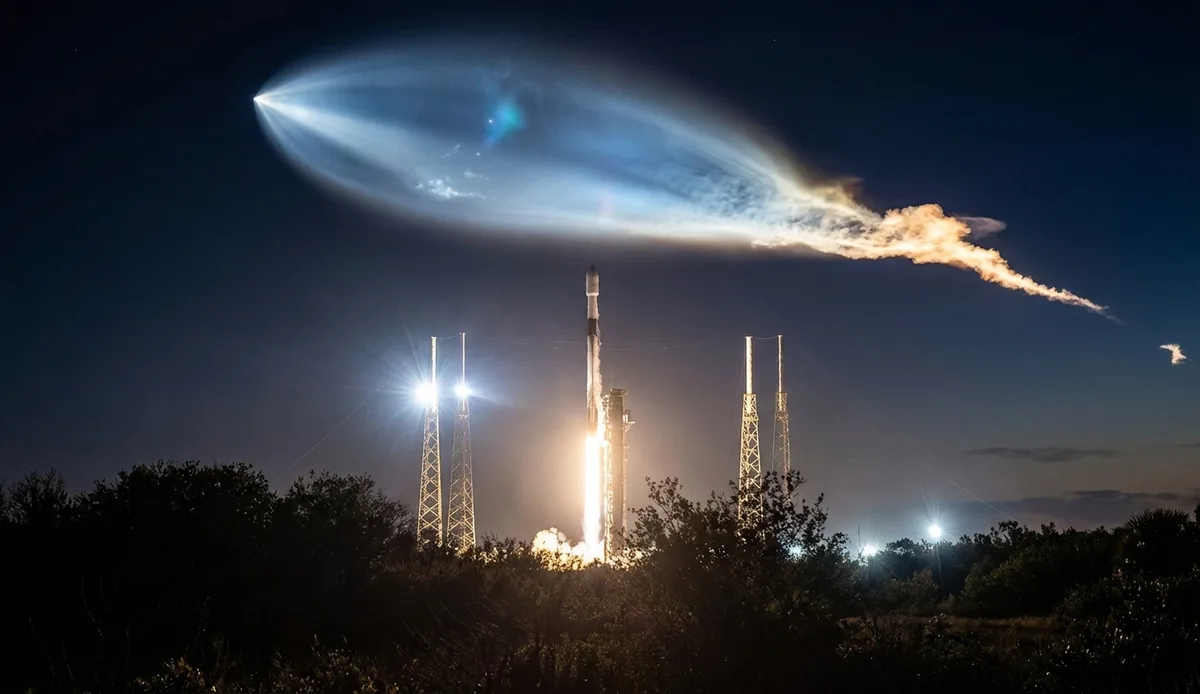
A SpaceX Falcon 9 rocket lit up the predawn sky over Brevard County on March 4, 2026, with a rare 'jellyfish' contrail that stretched from Cape Canaveral to Tallahassee and parts of south Georgia. The Falcon 9 lifted off at 5:52 a.m. EST from Space Launch Complex 40 at Cape Canaveral Space Force Station on the Starlink 10-40 mission, carrying 29 satellites to low Earth orbit. Within minutes, the rocket’s exhaust plume formed a luminous, bulbous shape resembling a jellyfish, with radiating tendrils glowing white to blue against the dark sky. The phenomenon occurred as sunlight hit the plume high in the atmosphere while ground observers remained in shadow during twilight. Photographers in Cocoa Beach captured the effect, which was visible more than 200 miles north in Tallahassee. Social media filled with images and videos, with residents calling it 'magical' and 'otherworldly.'
The unusual visual effect, known as a 'space jellyfish,' happens when a rocket ascends rapidly into altitudes where the sun has already risen. Sunlight scatters off ice crystals and exhaust particles in the plume, creating vivid colors and the bulbous shape. NASA photographer John Kraus explained the optics in a post, noting the northeast trajectory of the Starlink mission allowed the plume to catch early sunlight. The expanding gases in the thin upper atmosphere formed a tentacle-like structure that diffused slowly against the predawn backdrop. The launch marked SpaceX’s continued expansion of its Starlink broadband constellation, with the mission’s success confirmed by the company’s tracking website. Residents across the Space Coast reported seeing the contrail for up to 15 minutes after liftoff.
Local skywatchers and photographers shared images showing the plume’s iridescent glow, with some comparing it to 'something from a sci-fi movie.' The event drew attention from amateur astronomers and aviation enthusiasts, who noted the rarity of the phenomenon. SpaceX has launched over 3,000 Starlink satellites since 2019, but the 'jellyfish' effect is less common due to specific atmospheric and lighting conditions. The launch was the second Starlink mission from Space Launch Complex 40 this year, following a successful deployment in January. No delays or issues were reported during the flight, and the first stage booster landed safely on a drone ship in the Atlantic Ocean. The mission’s success continues SpaceX’s role in expanding global broadband access from Brevard County’s launch sites.