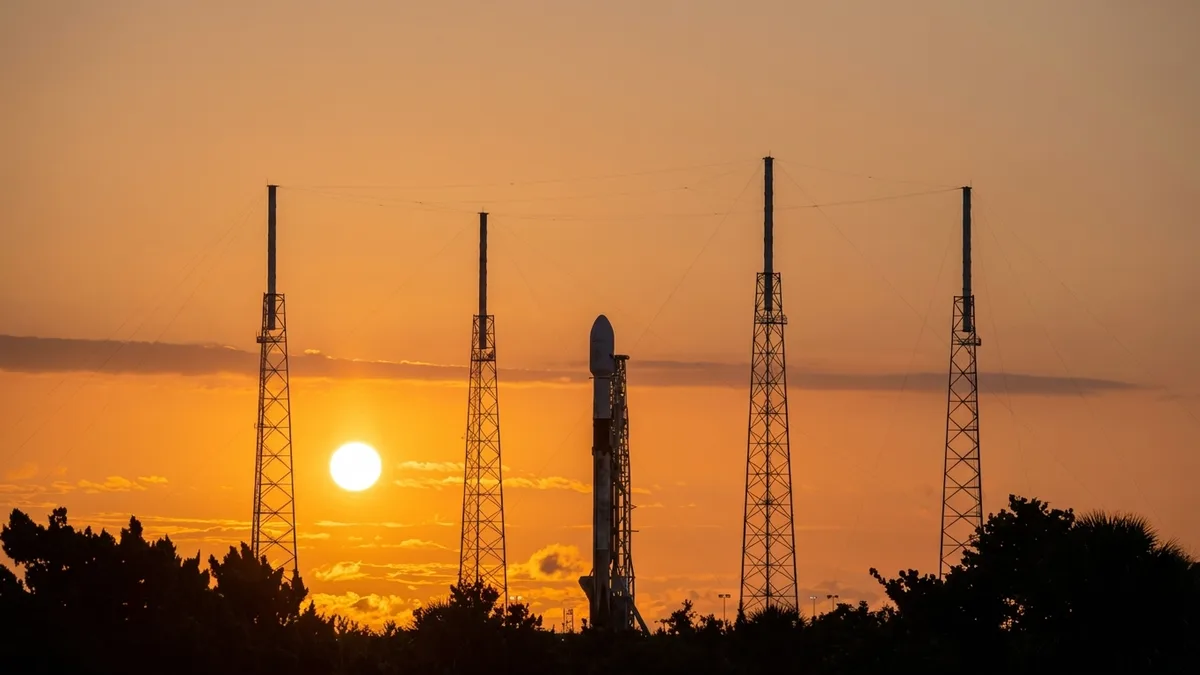
SpaceX has delayed its Starlink mission 10-48 launch from Thursday to Friday, but the window for the jellyfish effect remains open if the Falcon 9 rocket lifts off early. The new launch window runs from 6 a.m. to 10 a.m. ET on Friday, March 12, 2026, from Cape Canaveral Space Force Station’s Space Launch Complex 40. SpaceX did not specify the reason for the delay, though the 45th Weather Squadron gave a 90% chance of favorable conditions, with thick cloud layers and cumulus cloud rules as the main concerns.
The jellyfish effect, seen during last week’s Starlink launch, occurs when a rocket’s exhaust plume creates a glowing cloud resembling a jellyfish. This phenomenon is most visible near dawn or dusk, and residents across Florida reported seeing it during the earlier mission. If Friday’s launch occurs early in the window, similar skies could return. The effect happens as the rocket’s exhaust interacts with atmospheric moisture and sunlight, creating a temporary, luminous cloud.
The Falcon 9’s first-stage booster, B1095, will make its sixth flight. Previously, it supported Starlink missions 12-15, 10-56, 10-52, 6-86, and 6-101. After stage separation, the booster is expected to land on the droneship Just Read the Instructions in the Atlantic Ocean. This mission will deploy 29 Starlink satellites, part of SpaceX’s effort to expand global broadband coverage.
The 45th Weather Squadron’s forecast highlights the importance of timing for both the launch and the jellyfish effect. Thick cloud layers could obscure visibility, but if conditions align, the spectacle may repeat. SpaceX’s Starlink program continues to operate from the Cape, with frequent launches from Space Launch Complex 40. The company has not yet provided updates on the delay’s impact on the mission’s timeline or satellite deployment schedule.