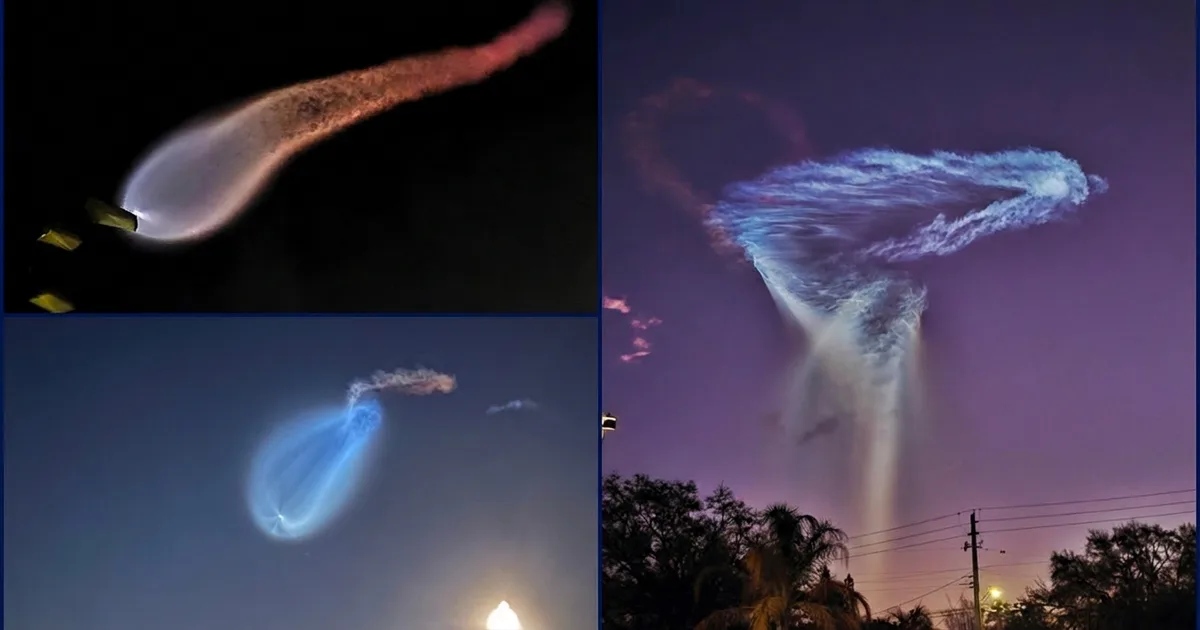
A SpaceX Falcon 9 rocket launched 5:43 a.m. Wednesday from Space Launch Complex 40 at Cape Canaveral Space Force Station, sending 53 Starlink satellites into orbit. The rocket’s exhaust created a luminous blue glow in the sky, dubbed a 'space jellyfish' by observers. The effect occurred as sunlight reflected off the rocket’s exhaust plume high in the atmosphere.
FOX 35 meteorologist Brooks Garner explained the phenomenon forms when sunlight interacts with particles in the rocket’s exhaust. The blue glow was visible along Florida’s eastern coast and as far north as Georgia, according to Garner. Local residents and photographers captured dozens of images showing the swirling, jellyfish-like shape against the morning sky.
The launch marked SpaceX’s 13th Starlink mission this year from Brevard County. The company aims to deploy over 12,000 satellites globally to provide broadband internet. The space jellyfish effect is not unique to this launch but occurs during certain atmospheric conditions following rocket flights.
Residents in Cocoa Beach, Titusville, and Melbourne reported seeing the glow during the early morning hours. Social media posts showed the phenomenon appearing as a faint blue halo expanding above the rocket’s path. SpaceX did not comment on the visual effect, but the company’s website confirms the launch details and mission objectives.
The space jellyfish is a temporary optical phenomenon, lasting only minutes as the exhaust particles disperse. Similar effects have been documented after other rocket launches, though the specific conditions required for visibility are rare. Local astronomy groups said the event provided a unique opportunity for skywatchers to observe a scientific process in action.