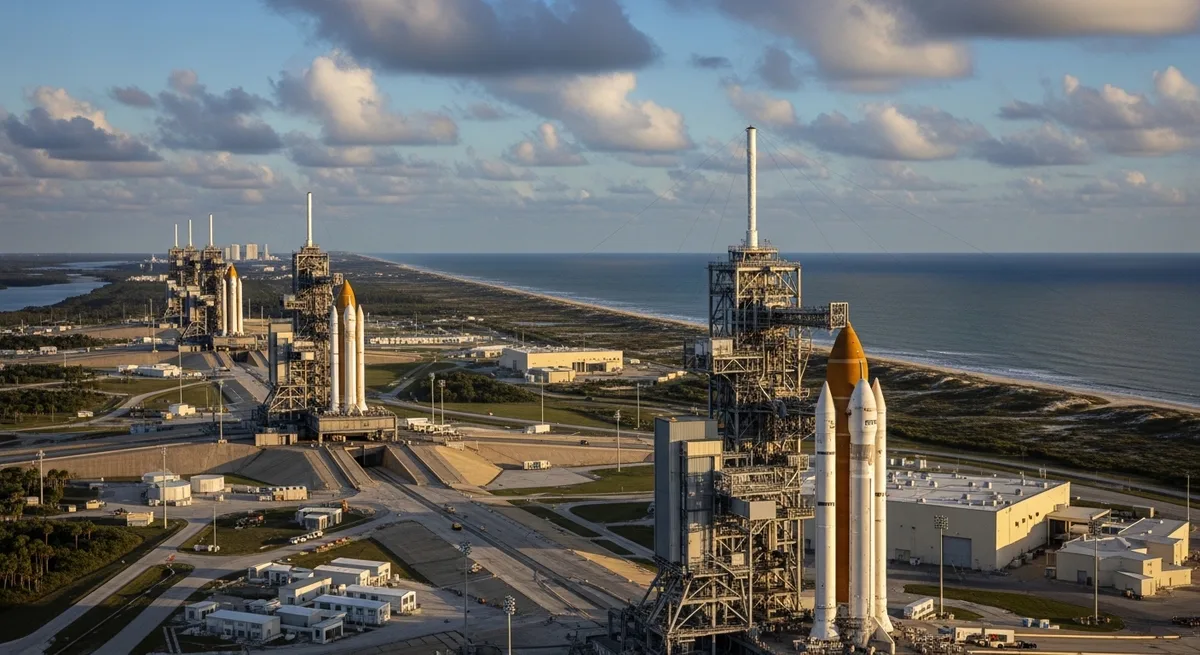
A United Launch Alliance Atlas V rocket lifted off from Cape Canaveral Space Force Station’s Space Launch Complex 41 on Thursday, July 2, 2026, carrying 29 satellites for Amazon’s Leo 8 mission. The launch marked the first of what could be a record-breaking year for the Space Coast, which ended 2025 with 109 orbital launches—the highest number in a single year since tracking began. SpaceX, United Launch Alliance, and Blue Origin all increased their activity in 2025, while NASA’s Artemis II mission is set to debut in 2026.
In 2025, the Space Coast saw 109 orbital launches, including 83 from Cape Canaveral and 26 from Kennedy Space Center. SpaceX accounted for 101 of those flights, all on Falcon 9 rockets, while United Launch Alliance contributed 6 and Blue Origin added 2. The year also included four human spaceflights: SpaceX’s Crew-10 and Crew-11 missions, Boeing’s Crew Flight Test, and Axiom Space’s Ax-4. A hypersonic missile test added to the tally, making 2025 the busiest year yet.
2026 is shaping up to be equally active, with 44 orbital launches projected through July 2. So far this year, 42 have come from Cape Canaveral and 2 from Kennedy Space Center. SpaceX leads with 37 launches, including 36 Falcon 9 and one Falcon Heavy. United Launch Alliance has completed 5, with four Atlas V missions and one Vulcan. Blue Origin added one New Glenn flight for the NG-3 mission, and NASA is set to launch the Space Launch System rocket on Artemis II. Two human spaceflights—Crew-12 and Artemis II—are also scheduled.
The Space Coast’s 2024 saw 93 launches, with SpaceX responsible for 88 flights, and 2023 had 72, led by SpaceX’s 68 missions. Relativity Space made one launch in 2023, but no other commercial providers have operated from the Space Coast since. As of July 2026, the region has already matched its 2025 launch count for the year, with more missions expected as SpaceX, ULA, and NASA ramp up operations. Updates on future launches will be posted regularly.