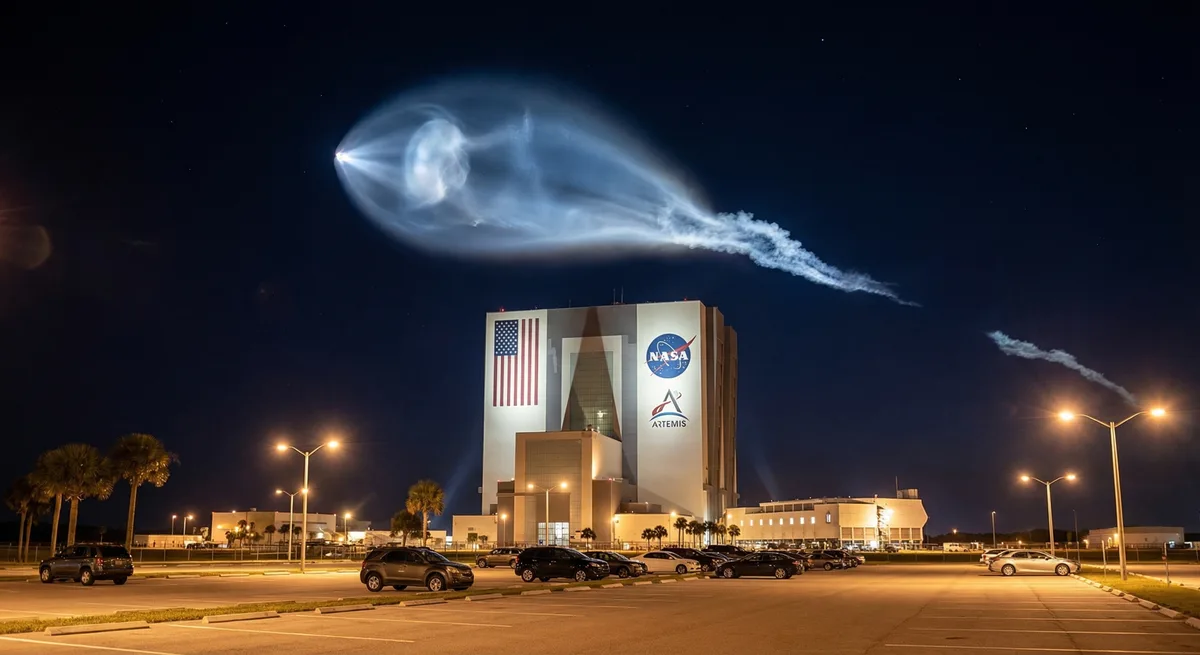
A Falcon 9 rocket launched from Cape Canaveral Space Launch Complex 40 on March 4, 2026, created a glowing 'space jellyfish' effect visible across Brevard County. The phenomenon occurred shortly after sunrise when sunlight reflected off the rocket's exhaust plume high in the atmosphere. Meteorologist Eric Burris explained the effect is common during launches near dawn or dusk. 'The Earth’s not blocking the sun yet, so the rocket catches the sunlight while we’re still in the dark,' Burris said. 'It’s one of the cooler things you see from a launch.'
The space jellyfish appears as a bright, glowing cloud trailing the rocket, resembling a jellyfish with its long, trailing tentacles. SpaceX confirmed the launch was part of a routine mission to deploy Starlink satellites. The event drew widespread attention on social media, with residents sharing photos of the illuminated plume over the Space Coast. 'It looked like something out of a sci-fi movie,' said Sarah Mitchell, a resident of Cocoa. 'I’ve never seen anything like it.'
The launch was the first of three planned SpaceX missions in March 2026. The next Falcon 9 launch is scheduled for Monday, March 11, from the same launch complex. NASA officials said the space jellyfish effect is a natural byproduct of rocket exhaust interacting with sunlight. 'It’s a reminder of how the Earth’s atmosphere reacts to human activity in space,' said Dr. Lena Torres, a planetary scientist at the University of Central Florida. 'It’s a beautiful, if temporary, spectacle.'
Residents in Titusville, Palm Bay, and nearby areas reported seeing the glowing plume for several minutes after liftoff. The phenomenon is most visible when launches occur within 30 minutes of sunrise or sunset. SpaceX has not commented on the visual effects of its launches, but the space jellyfish has become a popular topic among space enthusiasts. 'It’s a unique way to see a rocket launch,' said Mark Reynolds, a local photographer who captured the event. 'You’re not just watching a rocket go up—you’re seeing light interact with the sky in real time.'